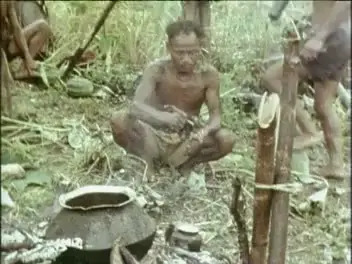
Of the hundreds of versions of the Ramayana, Sabil Alun, is a living oral tradition of the animistic tribal society of the Karbis of Assam. The Film is an attempt to recreate the tale in a contemporary context where the animistic point of view gets prominence.
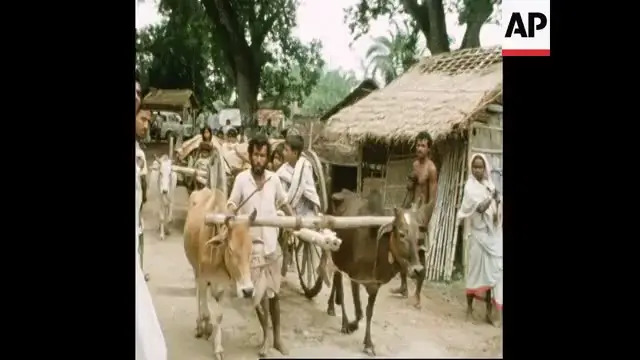
Three million Bengali refugees are crowding into camps in the frontier towns of West Bengal, and the Indian authorities expect the final total to reach six, or even seven millions. The cost of providing food, shelter and clothing for such a multitude is far beyond the physical or financial resources of India. Mrs. Gandhi has declared that India cannot be permanently saddled with an extra six million people. What concerns her is that a 'Palistinian' situation could develop, with Bengali guerrilla organisations drawing support from the discontented homeless in the camps and thus creating further unrest in an already unstable part of India. Some Indians are now saying the problem can only be solved by fighting a short war with Pakistan and thus imposing a settlement under which the refugees could return to their homes in East Bengal.
Rocking the Hills' is a journey into the musical traditions of the states of North East India. Music plays an important part in these states as it represents a natural harmony in the culture. As much of the parts are English speaking, musical genres like jazz, blues, country and folk get intertwined and hybridised with the local tunes and what emerges is a unique Indo-Western composition. The film features bands like Soulmate, Great Society and Abiogenesis and some of their music, which reflect the emotions and conditions the people in the North East share. The world record for the biggest guitar ensemble is also featured in the film.
Over the last 50 years the government has built 14,000 kilometres of embankments in an attempt to tame the rivers of eastern Uttar Pradesh, Bihar, Assam and Orissa. Despite this massive expenditure, losses due to flooding and the area that is now vulnerable to flooding has increased. 16% of Bihar is now permanently waterlogged, a direct consequence of the construction of embankments.''River Taming Mantras' explores the technological, economic and political rationale that underlies the adoption of such flood control measures. The film argues that because these rivers carry an enormous silt load, they have enormous power. Attempts to control these rivers are unlikely to succeed. On the other hand, the vast sums spent on the building and maintenance of these embankments provides endless opportunities for the siphoning of funds. Ultimately, it is the poor people who suffer - migrating to other states, towns and cities in search of food and shelter.
Ritual Journeys is an intimate portrait of Merayk, an 80 years old Lepcha shaman or Padim. Merayk lives with his family in Dzongu, a Lepcha reserve in North Sikkim, Eastern Himalayas. He performs healing rituals for individuals as well as rituals for the well-being of the household, the clan and his village community. Cameraman Dawa Lepcha followed Meyrak and recorded his daily life and rituals between 2003 and 2010.
The different religions of the world are basically different means to help us to a common end, falling in love with God. People don’t hesitate to fight in the name of their religion. Religion is not a means to increase their attraction to God, but a means to prove their own superiority over others, “My religion is better than yours and so I am better than you. What the world needs today is sincere spiritualists who want to improve, not prove. The world needs people who want to improve the quality of their own devotion and service to God and to all his children, and not prove their own superiority over the other children of God and justify it in the name of God.
The Film documents an indigenous effort by the Angami Nagas, traditionally known for hunting, which has saved diverse eco-systems and the beautiful Tragopan bird from extinction in Nagaland.
Manas is a National Park and animal reserve in Western Assam. In the last decades two issues have become critical and have been successfully solved: the reintroduction of endangered species like the Rhino or the Bengal Florican, and the involvement of local communities to restrict and overcome poaching. 'Resurgent Manas' presents a dual narrative: on the one hand it provides samples of the various species that are present in the Park, while on the other it explains how the success of the Park has been possible through important initiatives. The result is a documentary that underlines the importance of a symbiotic relationship between all living species.
SOS Children's Villages has been present in India since 1963, their work developed rapidly all over the country and they started their activities in Shillong in 1999. Shillong is located in the north-eastern region of India, in an area renowned for its natural beauty and sometimes called the "Scotland of the East". SOS Children's Villages in Shillong is situated outside the city centre, on a green hill covered with pine trees. The land was donated by the Government of Meghalaya. Tehy continue to work closely with local agencies and community-based organisations in order to identify families who are in need and then provide them with the support they require to improve their lives.
Two long-exiled rebel leaders who want greater rights and a larger homeland for the Naga ethnic minority in northeast India arrived in New Delhi on Thursday for high-level peace talks aimed at ending one of Asia's longest running separatist conflicts. Isak Chishi Swu and Thuingaleng Muivah of the National Socialist Council of Nagaland flew from Amsterdam to New Delhi airport for their first visit to the Indian capital in 37 years. They met the Indian Prime minister Atal Bihari Vajpayee Thursday evening, but did not disclose what was discussed at the meeting.
Watch, as the 13 ngos belted out their anger towards the government on influx issue, and demanded the inner line permit to be implemented in order to tackle the menace of infiltration.
Carrying back the rice. On the way back we and many of the people carrying back loads of rice were caught in a thunder storm with heavy rain. But the Konyaks ignored the rain and we met people going once more to the fields to bring up new loads. One young woman we knew made four trips in all. (From the field notes of Christoph von Furer-Haimendorf: 1970-08-29)
An exploration of the indigenous religion of the tribal groups of Arunachal Pradesh, their adaptation to new religions and to a globalised notion of ‘God’.
The film attempts to understand the relationship of a traditional hunting community, the Yimchungrü tribe of Nagaland; with the animals and birds found in the forests around their village, Fakim. It shows the significance of hunting in a tribal society and ways in which it is adapting to a rapidly changing cultural and ecological landscape.?Situated near the Indo-Myanmar border in Nagaland, Fakim is a small village, where the people share a unique coexistence with the environment. In the urban world, the word ‘hunting’ has several preconceived notions attached to it. It is often perceived as a taboo and never regarded as an art or a tradition. Rooted in rich culture, this film intends to re-define hunting as a concept, as seen in the past, the present, and in the future.??The film explores if it is possible to reach a balance between the practice of hunting and the practice of conservation. The film does not look at the act of hunting in isolation, but reveals a complex web of interdependencies of the people with the forest and the society they live in.
The film showing the visit India's Prime Minister, the late Indira Gandhi to the north-eastern states of Assam and Meghalaya to personally see the progress achieved there under the 20-Point Programme announced by her.
Late PM of India Rajiv Gandhi visited the state of Meghalaya to inaugurate the Balphakram National Park on 27th Dec 1987. PM’s visit to Andhra Pradesh and Tamil Nadu., PM’s visit to Shantiniketan (W.B.)., PM dedicates Hydro-Electric Project.
September 11 and Osama bin Laden have been turned into theatre drama by a production house in India. Recent American and world history have been turned into a play by Shankerdev Theatre, one of the top mobile theatre groups in Assam. In the play, a young Assamese man, Partha Kakoty, is a reporter with The New York Times when Osama bin Laden sends aeroplanes into the World Trade Center on September 11. Partha travels to Afghanistan, where his assignment is to interview bin Laden and ask him why he carried out such a terrible crime.
Film shows people of Tripura have been provided with plotted unreserved forested area by " Patta ", a resolution passed by the parliament in 2006 to distribute land Patta among the people near the forests. These people succeeded in improving quality of the forests.
Pang Lhabsol, Sikkim’s most important indigenous celebration, consists of a series of rituals and monastic dances held in honour of Sikkim’s chief mountain deity, Khangchendzonga, and all the land’s guardian deities. Considered the true custodian of the land, its people and resources, Khangchendzonga is also revered as the defender of the Buddha Dharma and the land’s peace and prosperity.
This film describes the variety of tribal population in India with their distinctive culture patterns, dress, decoration, dance and music. Tribal inhabitants of this country number some 25 milion and belong toa hundred and severty two different groups scattered through the length any breadth of this sub-continent. The hilly tracts of Central India are inhabited by the Gonds. The Santhals are to be found in Bihar, Orissa, Bengal and Assam while the Todas live in the Nilgiris of South India. The Bhills reside in the remote regions of Maharashtra State and Rajasthan and the Nagas in the lovely Assam hills.
The film draws as its theme a picture of the beautiful, lovely orchid flowers of Manipur, in their assorted varieties and environment. The connected lores are also emphasised.
Elephants are found in plenty in the jungles of South India, Assam and Orissa, Each elephant fetches anything between Rs. 3,000 and 8,000. Most elaborate arrangements are made to trap these wild animals and the risk involved in these operations is considerable. This documentary relates the exciting story of this hazardous adventure.