Indians fighting in World War Two. Far East. Sea warfare, ships fire depth charges. Indian troops or airmen training. Flying for the RIAF Royal Indian Air force. Burma - Flying over Burma. Aerial views of Burma. Monsoon in Burma. Scenes of warfare.
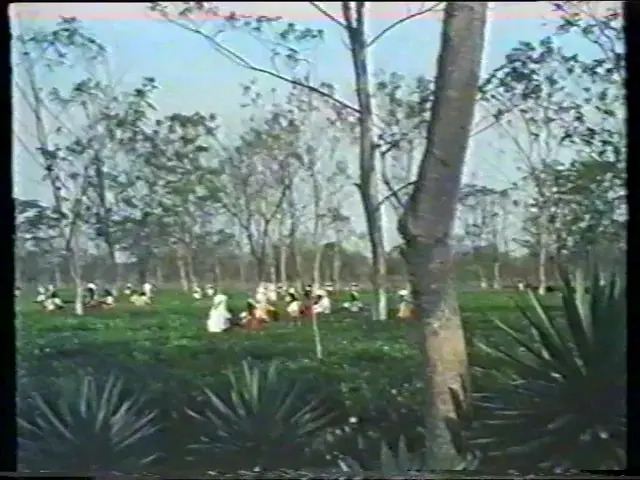
Tea Production in India in the 1920's. Tea plantation. Colonial India. Ground is prepared by large number of Indians who use mattocks to ready the soil. Tea seeds are tested by being floated in water. Seeds are planted in holes made by a stick and pulverised earth placed on the seed in the hole. Large number of agricultural workers.
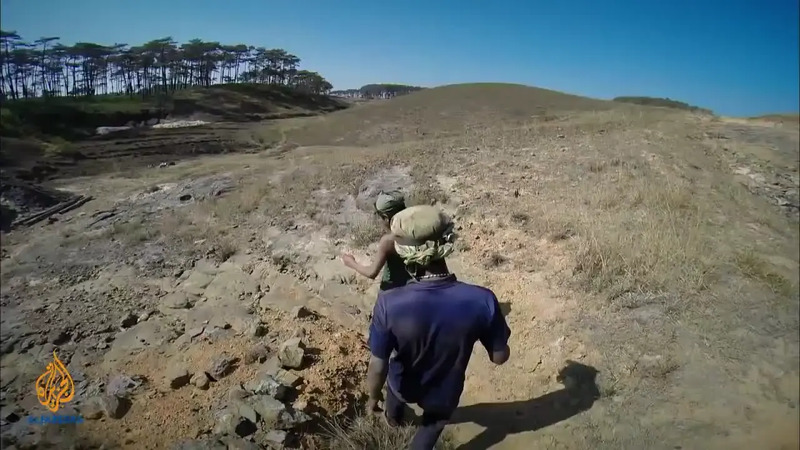
Karma,16, has worked as a miner for over a year in India's northeastern state of Meghalaya, crawling deep inside a 'rat-hole' tunnel to dig coal for seven hours a day. "Inside it is very unstable. The smell is awful," he said sitting on a pile of coal. "It is so dirty, and it is difficult to move. You breathe in the coal and the dust. People get sick like this. There is no water to drink and it is so muddy. It is not nice at all." Child rights activists have reported that there are thousands of children like Karma working in Meghalaya's coal pits, because only those who are small in size are able fit in the claustrophobic tunnels. Many of them, like Karma, are believed to be from neighbouring Indian states, or from nearby Nepal and Bangladesh.
A stage version of the Hollywood blockbuster and real life story "Titanic" is running to packed houses in the north-eastern Indian state of Assam. The play is based on the film about a couple who fall in love on the maiden voyage of the world's biggest ocean-liner, which sank in the Atlantic Ocean in 1912.
"A message of mutual understanding and let us work together and above all, let us avoid the suggestion of using the name of religion, any religion, for persecuting or harassing others. Because this is quite unacceptable. It is against the very same idea of religion, any religion." SUPER CAPTION: Joaquin Navarro-Valls, Papal spokesman Despite the demonstrations in the build up to the Pope's trip, the three day visit has been peaceful, with the Pontiff cocooned from protests by a thick cordon of security. The Vatican has pleased the Indian government by announcing a 300-thousand U-S dollar contribution to the victims of the cyclone which has devastated eastern India. The papal visit was the Pope's second ever trip to India - the last one was 13 years ago.
Pope John Paul has arrived in India in a visit that has already been met with protests. Hindu fundamentalists have burned him in effigy. They want an end to conversions - and an apology for 16th-century killings by Portuguese colonialists during the Inquisition.
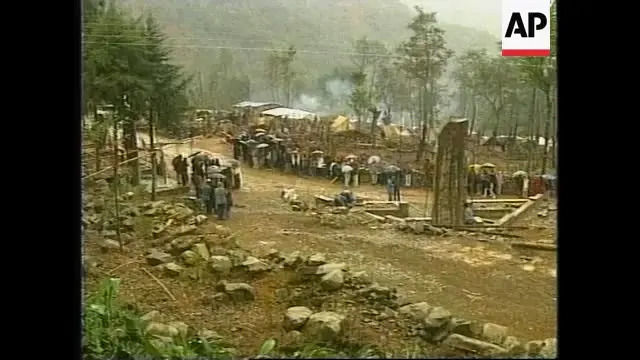
A centenary celebration of Christianity in an unlikely spot- - a tribal state in the wilds of Northeast India. The Angami tribals from all over Nagaland gathered in a remote village over the weekend to mark 100 years of a religion that has transformed their lives.
The Indian government has signed an agreement with the Bodo Liberation Tigers and the government of Assam which will create an autonomous self-governing body to be known as the Bodoland Territorial council. This council, which will be within the state of Assam is designed to fulfill the economic, educational and linguistic aspirations of the Bodo tribal group. Bodos, an ethnic tribe from the north eastern state of Assam, have been fighting for autonomy for many years. They had unilaterally suspended their militant activities on July 14, 1999 following the onset of peace negotiations.
February 18, 1961 will be long remembered in the history of the Nagaland when the people of the area witnessed the birth of the Interim Body and Executive Council for Nagaland. The new set-up was formed amidst great rejoicing and this film records the memorable and colorful event in detail.
The film examines the policy initiatives in the North East to increase its social, economic and cultural interaction with the rest of the country. North Eastern India, due to its geographical isolation has not been developed at par with the rest of the country. Now, the Government of India with its 'Look East Policy' has taken a step to rectify this situation. There have been new infrastructure initiatives within this region such as the setting up of a network of highways, railways and pipelines. With a large number of educated and English speaking youth emerging from these states combined with a policy of integrating with the neighbouring states, the 'Look East Policy' aims to transform North-East India as a thriving social and economic belt.
On the slopes above and below, groups of men and boys and a few girls of Shoupa's family were cutting the rice. The harvesters cut sheaves of rice-stalks and left them on the ground to be picked up by small boys who in turn carried them to the threshing hut. The reapers worked in lines or semi-circles, shouting as they proceeded with surprising speed. The effect was almost that of a machine, and plots of high waving rice-plants were suddenly reduced to bare ground where only the large leaves of taro plants emerged from heaps of cut rice-stalks. (From the field notes of Christoph von Furer-Haimendorf, 1970-08-29)
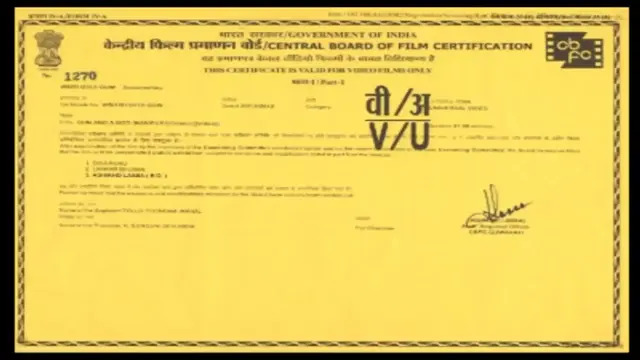
Purnima is having the best of her evenings with her inmates in a jail room. Yet her every laughs and giggles are concealing a grave conflict. The visiting hours in the jail are dreadful with no one to visit her. These are the times when she finds herself asking who she is. Tagged as a "disgraced inheritance", from an unknown father to a mentally unfit mother, her childhood was chastised. The reality of being an illegitimate child haunts during her teens and when she was married, it crucified her. A "Gun and a God" is the journey a woman, whose will was forged by the structural violence of her existence, who finally finds her voice in a Gun and justice in a God.
The Film explores the intricacies of Manipuri traditional handloom and its allied activities, unravelling mythology to understand the continuity of an age-old cultural tradition which is reflected in the socio-economic life of the Manipuri people.
Various shots of Maghis boatmen in the Lushai Hills, they walk up to the Holy One Tier U Baulie and pay tribute with offerings of candles. Various shots of him with his two daughters. Various shots of Chin Hill tribesmen patrolling the jungle. M/S of two men pulling a dead Japanese soldier from his foxhole. Various shots of Bofor guns firing in the jungle. Soldiers walk through jungle. C/U dead Japanese soldier lying in trench in jungle. Various shots of prisoners of war carrying other wounded soldiers. M/S of more prisoners of war, they stand with their heads bowed.
The story of how some underprivileged children, including Mr Dingko, an Olympian, the Asian Games gold medallist and Arjuna Award recipient, and some other inmates of an orphanage in Imphal have distinguished themselves to represent India in international sporting events.
In 2011-2012, a team from Meghalaya AIDS Control Society and a metal band 11th Hour took a road trip. And they discover a Meghalaya, not of the tourist brochure but a land devastated by mining, sexual hypocrisy, economic inequalities.
Life of Lou Majaw is surrounded in music. He is still the source of inspiration for young generation. He is one of the most respected musician in North East and in India. This biography of Lou Majaw will inspire the budding musicians especially in Meghalaya. He is a fun loving man and always enjoying and spending times with friends. His dressing styles is unique with his short jeans pant always, follows the Bob Dylan ways of playing music.
The film shows the improvement in the breed and milk yield of hill cows as a result of cross-breading with Jersey bulls through artificial insemination. Twelve cross-breeding units in India have helped to artificially inseminate about 10,000 hill cows, enabling the simple hill people to improve their means of livelihood with more and better milk and sturdier and healthier cattle.
This film gives a glimpse of a variety of Folk and Tribal dances of India like Tapu dance of Arunachal Pradesh, Naga dance of Nagaland, Nati dance of Himachal Pradesh, Dhanger dance of Goa, Bhoota dance of Karnataka, and Kaksar dance of Madhya Pradesh which shows that the rich cultural heritage of our nation has been preserved through the centuries by our people.
The documentary revolves around the lives of six street children – Nagesh, who is a child labour eking at a living selling channa, Ajay, a victim of child abuse who is mentally disturbed and is people wary. Rahul, a victim of domestic violence perpetuated by his own father, Nazir and Rafiq, two homeless kids who sleep in Police Bazaar street in a sack and Vikash, an under aged drug addict who is a member of a street gang. It focuses on the lives of these children to reveal the dark underbelly of the society that we often choose to ignore, which is titled “Few Angels in Hell”